Archive for February, 2009

Feb 27 2009

A Helpful Reminder for the Worrying Writer: It’s All Inventory

Published by Scott under Random Mutterings

I had to remind myself today, as I sometimes do, that there are only three things as a writer I really should be focused on:

1. Writing
2. Getting better at writing
3. Giving my books the best shot at reaching the widest possible audience

I can’t control the state of the economy. I can’t control how editors respond to my work. All I can do is write and strive to become the best writer I can be — studying other storytellers, digging deeper into myself, reaching for it. And when that’s done, I can make sure the books and stories get on the desks of editors who can help me reach as many readers as possible.

Beyond that? Not much.

Worrying about things beyond those three areas is a lot of wasted energy. Of course, it’s easier said then done sometimes, but the more focused I am on what I can control, the happier and more productive I am.

The good news? If you’re in this for the long haul, as I am, everything you write is inventory — whether it sells now or later. That’s the great thing about writing fiction. With few exceptions, it’s not date sensitive. We’re not writing newspaper copy here. I’ve had short stories I’ve sold ten years after I wrote them, so I’ve already seen this proven in my own life.

Feb 23 2009

The Literary Lottery

Published by Scott under On Writing

The first professional fiction sale I made was a short story set in somebody else’s universe.  It may also very well be the last time I write that kind of story. 

Let me explain.  This has nothing to do with how I feel about the story (I still love it) or the universe (the same).   The story, “Protecting Data’s Friends,” was purchased by Dean Wesley Smith for the Star Trek: Strange New Worlds anthology. For ten years, Pocket Books put out an annual collection of the best Star Trek stories from non-professional writers — meaning, writers who hadn’t sold a novel or more than three stories.  We were paid ten cents a word, and I still have a copy of that check framed on my wall as the first money I was ever paid for my fiction.  It was a great day when I learned I’d sold it.

So I have nothing but good feelings for that story.  There are writers out there who think it’s somehow shameful to write “media-tie-in” fiction, that it’s akin to slumming, but I don’t feel that way at all.  I also don’t begrudge any writer for writing stories or novels set in other people’s universes; if they’re having fun, and making money, it’s all good.  Growing up, some of the first books I cut my teeth on were media-related, which proves it really can be gateway fiction.

But here’s the deal.  If you play in somebody else’s sandbox, you don’t get to play the literary lottery. 

What’s the literary lottery?  If you write a book geared for a mass audience that’s completely your own work, every time it lands on an editor’s desk, you’re playing the literary lottery.  It may be a book that’s lucky to sell a few thousand copies or it may be the next Harry Potter.  It may garner you a modest advance or a mega deal of over six figures.  Or maybe it doesn’t sell at all.  You just don’t know.  That’s what makes it the literary lottery.  

Now, it’s true that very, very few books have the potential to be bestsellers.  In fact, at least two-thirds of the time, I’d be willing to bet good money after glancing at a book whether it does or doesn’t have that potential.  That’s not to say it’s a bad book.  It’s just that some books are slotted at a certain level.  But if you write a book set in somebody else’s universe — what’s usually called “work-for-hire” — in almost all cases you don’t own the copyright to that work.  If it becomes a mega seller, you may benefit beyond your initial advance, or you may not (it depends on your contract), but you have no control over that product.  With books that are a hundred percent your own, however, you have full control unless you sign any part of it away. 

So if you’re like me, with a day job, two kids, and a crazy busy life, you have to make certain choices with your writing time.  Right now, at my maximum, I think I can write three books a year, as well as a handful of short stories thrown in for good measure — that’s if I stick to my four or five pages a day quota.  Should I spend that time writing books geared for the widest audience possible, or should I write a book set in somebody else’s universe? 

Different writers will answer this question differently.  It can be tremendously fun playing in somebody else’s sandbox.  Like I said, I loved writing that Star Trek story.  But the next year, since the other stories I’d sold hadn’t been published yet, and I was still eligible for Star Trek Strange New Worlds, I wrote another one.  And guess what?  The editor didn’t buy it.  It’s okay, it happens, but now what?  Here’s the problem:  There were no other markets for that story. 

When I look at the three dozen short stories I’ve sold so far, less than a third sold the first time out of the chute.  I had one story I sold after a dozen rejections for over a thousand dollars.  Once your writing gets to a certain level, it’s mostly about taste and timing.  Sometimes a story (or a novel) needs to land on a lot of editors’ desks before it gets bought. 

For me, though, the most important reason for writing only my own fiction has nothing to do with the fiction itself.  It has to do with my finances.  You see, my day job completely covers my expenses.  This is important:  I don’t need the writing money to survive. 

This gives me a freedom that full-time professional fiction writers may not have.  When the mortgage payment is looming, or the creditors are filling up your answering machine demanding payment, you don’t have the same freedom.  Someday I may have that problem, but right now I can focus only on the books that have the highest probability of reaping me the biggest rewards.  Writers like to dream about going sans day job, but a day job does have certain advantages.

It allows me to play the literary lottery each time out of the chute.

So when someone asks me if I’ll ever write more Star Trek stories, and I say probably not, this is the reason why.  It’s not snobbery.  It has nothing to do with Star Trek itself — I love the universe, both the show and the books — and everything to do with having the freedom (a day job that pays the expenses) to do what’s best for my writing career long term. 

Of course, this doesn’t mean it will always work.  It just means I’m reaching for it.
Feb 20 2009

Postcards from the Garage: The To-Read Pile

Published by Scott under Postcards

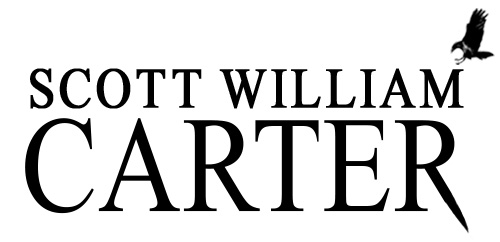
This is a picture of my “to read” pile, which doesn’t include another four or five books at my bedside.  Still, it’s a pretty good representation of my eclectic reading habits.  It’s also a good representation of how hard it is for me to say no to books.  Books, they are pretty, me likes them . . .

Feb 17 2009

Dispatches from the Frontlines of Fatherhood: Counting to Twelve

Published by Scott under Random Mutterings

Overheard in my backyard, a conversation between two five-year-olds:

Kat: Let’s play hide and seek. Turn to the tree and count to ten.

Friend: Okay. One . . . two . . .

Kat: Wait! That’s not long enough. Count to twenty.

Friend: But I can’t count to twenty! I can only count to twelve!

Kat: Fine, count to twelve then.

Feb 16 2009

10,000 Hours X 500 Words an Hour = ?

Published by Scott under On Writing

Most writers don’t like math, but I’m in the mood to talk about the above formula this morning.  First, let’s start with two numbers for the aspiring professional fiction writer: 

  • 10,000
  • 1,000,000

I was thinking about these two numbers this morning on my way to the day job.  I was thinking about how hard I’ve worked over the years to get myself into this position — where I’ve sold a book and three dozen short stories, and have two more books that I feel good about now out in editors’ hands.  There are no shortcuts, you know.  I sometimes get the feeling when I talk to aspiring writers that they’re looking for shortcuts — tips and tricks to spare them the long agonizing years of work to pound their craft into shape.  But no, the road is hard.  How fast you go down the road depends solely on how hard you’re willing to work.

But what does that mean?  That’s where those two numbers come in.  The first, 10,000, is the number of hours of concerted practice various assessments have determined it takes to reach a level of mastery in any field.  Let’s break that down.  If you practiced an hour a day, every day for a year, you’d end up with 365 hours.  If you did that for ten years you’d have 3650 hours.  How long would it take to reach 10,000 hours at one hour a day of practice?  The answer is 27.4. 

However, when they’ve studied professional musicians, they find that those who achieve mastery (even the really young ones) practice more than an hour a day.  In fact, it’s closer to three to four hours a day.  At three hours a day of practice, that would be 1095 hours.  Let’s say you miss a few days here and there due to illness and other matters and round it off at 1000 hours.  So according to this formula, if you practiced three hours a day, you’d achieve mastery in about 10 years.  Which, interestingly enough, is about the length of time they’ve found for very serious musicians.  If they start seriously practicing at age 10, they achieve mastery at age 20 and everyone hails them as geniuses when in fact they just put in the hours. 

This is why I tell people I wish I worked harder earlier on.  The people who achieved early success in writing did so because they worked harder, not because they were more gifted.  I didn’t realize how hard I needed to work until I reached my mid twenties. 

The other number, 1,000,0000, is the number of new words of fiction many professional writers say you have to write before you get anywhere close to a publishable level.  Let’s break this number down, too.  Most writers shortly get up to a speed of two to three manuscript pages an hour, which is 500-750 words.  Some more, some less, but the bulk of professional writers fall in that range.  Let’s be conservative and say it’s 500 words.  How many hours would you need to write to reach 1,000,000 at that pace?  About 2000.  

Ah, you think, so it’s easier to reach mastery as a writer than as a musician.  Oh, no.  Remember, I said publishable.  That’s akin to being able to get paid to play the piano at your local bar; it means you’re good enough that someone’s willing to fork out some cash for your work.  It doesn’t mean you’ve reached mastery.  What’s mastery?  Well, that depends on your goals, of course, but the bare minimum, I think, would be making a good living from your craft. 

Let’s turn it around another way.  How many words would we write at 500 words an hour for 10,000 hours?  Well, that’s 5,000,000 words. 

And I think that’s a pretty good benchmark.  Ten years of practice at three hours a day, every day, will get you there.  If you put in an hour a day, take thirty years. 

Seem daunting?  Good.  It’s not a road for the faint of heart, so turn back now if you don’t want to put in the work.  Me, I’m hoping my hard work graduates me from playing at the local bar to making a good living at my craft.  How long will it take me to get there?  Well, let me see, let’s crunch some numbers . . . 

Nah, I’m better off spending that time practicing.

Feb 13 2009

Postcards from the Garage: Peace in the Middle East

Published by Scott under Postcards

Actually, I always find it funny that our black cat, Grimmy Lynn, prefers the company of our dog, Mankato, over the company of our other cat. Of course, Mankato merely tolerates her . . .

I realize this now puts me in the company of other writers who post pictures of their pets online. Sigh.

Feb 09 2009

Dispatches from the Frontlines of Fatherhood: The Two-Year-Old Driver

Published by Scott under Fatherhood

Me: Okay, Calvin, time for you to take the wheel.

Calvin: No!

Me: Oh, come on. Daddy’s tired, so you need to drive us home. I’ll ride in the car seat.

Calvin: No! I might hit people’s dogs!

Me: Well, that’s very thoughtful of you. What about the people? Aren’t you worried about hitting them?

Calvin: [Silence]

Feb 02 2009

Recent Reads

Published by Scott under Scott Recommends

  •  Outliers, by Malcom Gladwell.  The story of success.  I’ve read Gladwells other two nonfiction bestsellers, and this one was just as compelling a read.  Gladwell focuses on the circumstances — both good and bad — that allow people to become extraordinarily successful.  The lesson?  If you understand that the “self-made man” is only a small part of the story, then you can grant more people the opportunity to become successful.  However, I’m not sure I buy the author’s premise completely.  There are obviously people who are granted the same opportunities and don’t do anything with them.  Determination and persistance will still take you far in life. 
  • Nightmare in Pink, by John D. MacDonald.  A young NY banker is killed and McGee goes looking; ends up falling in love with the young man’s fiance.  Drugs.  An experimental wing of a psychiatric ward.  I’ve now read about half of the Travis McGee series (there’s twenty-two in all), and you could definitely tell this was one of the early efforts.  Still, it’s always great to spend a few hours with McGee.  It’s like seeing an old friend.
  • Stephen King, Duma Key.  A wealthy Minnesota building contractor suffers a terrible accident and loses his right arm.  He soon discovers a buried talent for painting — and finds himself summoned to Duma Key, off the Florida coast.  The rest is typical King, and fun — ghosts, paranormal power, etc.  You always want to go along for the ride so long as the characters are good, and Edgar Fremandle is a good one.  Perhaps not his best, but good.  I was, however, struck with how similar the ending was to “Rita Hayworth and the Shawshank Redemption.”  For a writer, all the stuff about the life of an artist was an extra bonus. 
  • Team of Rivals, Doris Kearns Goodwin.  A great, Pulitzer-winning biography of Lincoln that focuses on his bold, judicious cabinet.  It’s all the talk today because of Barack Obama’s fondness for the book and his own choice to fill his cabinet with strong opinions and strong personalities.  A long book, though, and it took me months to get through as I kept getting distracted by other books.  What I found so fasincating was how this little-known prairie lawyer, who was at first seen as a lightweight his other cabinet members might boss around, quickly came to command the respect, adoration, and even love of his once-time rivals for the Republican nomination. 
  • Rogue Moon, by Algis Budrys.  A short (180 page) classic of science fiction regarding an alien “death machine” found on the dark side of the moon, a transporter that essentially duplicates a human being (which indeed plays a part), and a fascinating assemblage of characters.  I’d been meaning to get to this one for a while, and I’m glad I finally did.  You can see how many later works of science fiction owe a debt to Budrys.